Black Body Radiation Experiment Pdf Free
Chapter 1 Blackbody Radiation Experiment objectives: explore radiation from objects at certain. 2.Is the emission from the black and white surface similar? The complete solution for demonstrating the blackbody spectrum of light intensity for a light. Blackbody Radiation Experiment - EX-5529A.
The color () of black-body radiation depends on the temperature of the black body; the of such colors, shown here in, is known as the. Black-body radiation is the within or surrounding a body in with its environment, or emitted by a (an opaque and non-reflective body). It has a specific spectrum and intensity that depends only on the body's temperature, which is assumed for the sake of calculations and theory to be uniform and constant. The thermal radiation spontaneously emitted by many ordinary objects can be approximated as black-body radiation. A perfectly insulated enclosure that is in thermal equilibrium internally contains black-body radiation and will emit it through a hole made in its wall, provided the hole is small enough to have negligible effect upon the equilibrium. A black-body at room temperature appears black, as most of the energy it radiates is and cannot be perceived by the human eye. Because the human eye cannot perceive colour at very low light intensities, a black body, viewed in the dark at the lowest just faintly visible temperature, subjectively appears grey (but only because the human eye is sensitive only to black and white at very low intensities – in reality, the frequency of the light in the visible range would still be red, although the intensity would be too low to discern as red), even though its objective physical spectrum peaks in the infrared range.
When it becomes a little hotter, it appears dull red. As its temperature increases further it eventually becomes blue-white.

Although planets and stars are neither in thermal equilibrium with their surroundings nor perfect, black-body radiation is used as a first approximation for the energy they emit. Are near-perfect black bodies, in the sense that they absorb all the radiation that falls on them. It has been proposed that they emit black-body radiation (called ), with a temperature that depends on the mass of the black hole. The term black body was introduced by in 1860. Black-body radiation is also called, cavity radiation, complete radiation or temperature radiation.
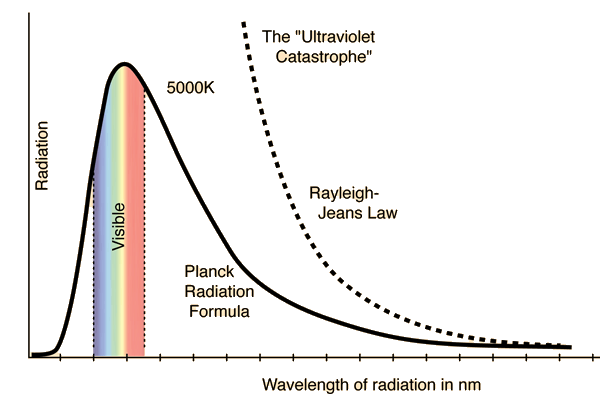
Lean On Me The Best Of Bill Withers Rarity. Contents • • • • • • • • • • • • • • • • • • • Spectrum [ ] Black-body radiation has a characteristic, continuous that depends only on the body's temperature, called the Planck spectrum. The spectrum is peaked at a characteristic frequency that shifts to higher frequencies with increasing temperature, and at most of the emission is in the region of the. As the temperature increases past about 500 degrees, black bodies start to emit significant amounts of visible light. Viewed in the dark by the human eye, the first faint glow appears as a 'ghostly' grey (the visible light is actually red, but low intensity light activates only the eye's grey-level sensors). With rising temperature, the glow becomes visible even when there is some background surrounding light: first as a dull red, then yellow, and eventually a 'dazzling bluish-white' as the temperature rises.
When the body appears white, it is emitting a substantial fraction of its energy as. The Sun, with an of approximately 5800 K, is an approximate black body with an emission spectrum peaked in the central, yellow-green part of the, but with significant power in the ultraviolet as well. Black-body radiation provides insight into the state of cavity radiation. If each of the equilibrium radiation in an otherwise empty cavity with perfectly reflective walls is considered as a degree of freedom capable of exchanging energy, then, according to the of classical physics, there would be an equal amount of energy in each mode. Since there are an infinite number of modes this implies infinite (infinite energy at any non-zero temperature), as well as an unphysical spectrum of emitted radiation that grows without bound with increasing frequency, a problem known as the. Instead, in quantum theory the of the modes are quantized, cutting off the spectrum at high frequency in agreement with experimental observation and resolving the catastrophe. The study of the laws of black bodies and the failure of classical physics to describe them helped establish the foundations of.