Microsoft Equation Editor Mac 2011
Hey deer mac users. I just got my macbook pro instead of my old windows computer. In word for microsoft you can solve equations by using wordmat.
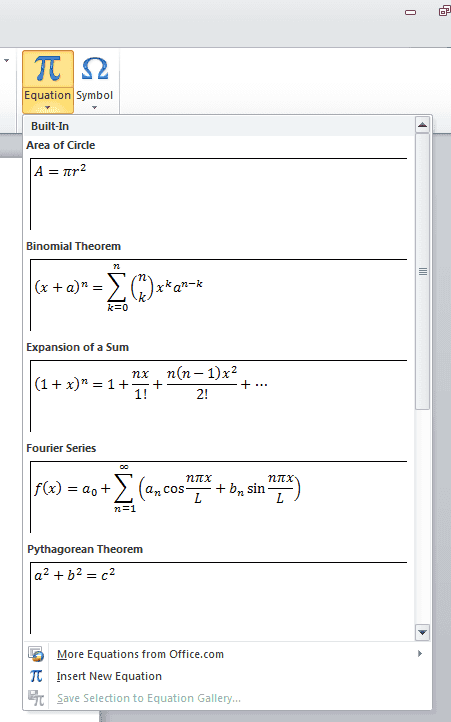
Excel 2010 Equation Editor The Equation Editor in Excel 2010 is difficult to navigate at first. The second time I tried creating an equation it got slightly easier, and the third time with the same equation (shown below) I seemed to almost get the hang of it. The trick I learned was to just type the equation in and let the Editor do its thing in rearranging what you’re typing. On the Equation Tools Ribbon are two helpful selections: Professional and Linear (shown below). Playing around with these helped me understand how the Editor can manipulate simple equations. Right Side of Equation Tools Ribbon Clicking the Equation drop-down arrow will reveal several predefined equations that can be inserted as starting point for your equation.

This how I started my first equation, which did me no favors. I fared much better just typing in the formula and letting the Equation Editor move things around. One Annoyance One of the problems with the Equation Editor is that if you stray to far outside the equation, yet still inside the text box, the Equation Tools tab disappears and you’re stuck with the Drawing Tools tab only. Google Docs Mathematical Equations I looked at the new and it seemed easier to learn, but is not nearly as powerful as the Equation Editor. Simcity 5 Limited Edition Iso Crackers on this page.
For example, the equation I created above was done in a Google Docs document with Mathematical Equations. I wasn’t able to do a strikethrough for the min text, like this: min.
And there wasn’t a good way to export this object out of Google Docs. Colorspan Sevice Manual. Equation Editor in Word 2011 for Mac The Equation Editor in Word 2011 for Mac looks to be identical to the one in Excel 2010. You start an equation from the Document Elements tab on the Ribbon, by clicking Equation or the drop-down menu arrow and selecting a built-in equation. The Equation Tools tab immediately becomes visible and active after starting an equation.
I created the same formula with relative ease. I kind of like the feel of this Word 2011 version better than what’s in Excel 2010. I’m not so sure that the equation editor is all so new I’ve been using Microsoft Equation 3.0 as part of the 2003 Office Pack at work for quite a while. I haven’t started to use 2010 yet, so I can’t fully compare.
Under 2003 Office products, choose Object from the Insert menu, and then scroll down to the Microsoft Equation 3.0 object. If it isn’t installed, search on “equation” in Help and follow the directions under the entry for “Insert an equation” for how to install Microsoft Equation 3.0. It isn’t the greatest product, but it works, and the stuff you have here about 2010 looks very familiar. I see what your talking about in Excel 2003. Didn’t know that Microsoft Equation 3.0 even existed, but it also shows up in Excel 2007 and Excel 2010 as the same thing, which is to say an embed object. The Equation Editor in Excel 2010 is an altogether new offering (my reference here is Excel 2010 Bible) that inserts a text box, not an embedded object, and has some very advanced toolbar features for entering symbols and such. Thanks for pointing out the Microsoft Equation 3.0 feature for entering equations in older versions of Excel.
Compatibility between Office programs seems lacking in 2010. I think Microsoft needs to get their act together.
For instance: If you copy and paste the equation object from Word to Excel, you only get a picture object. If you copy and paste the equation from inside the object from Word to Excel, you get an editable equation, but some information may be lost (for instance if you inserted a symbol from the symbol editor instead of from the equation editor it will be lost). If you copy and paste the entire equation object from Excel to Word, you still retain the equation, but it has an extra text box surrounding it. If you copy and paste just the equation from inside the equation object from Excel to Word, the equation appears the same as if you created it in Word.