Puppet Pin Tool After Effects Cs6 Tutorials
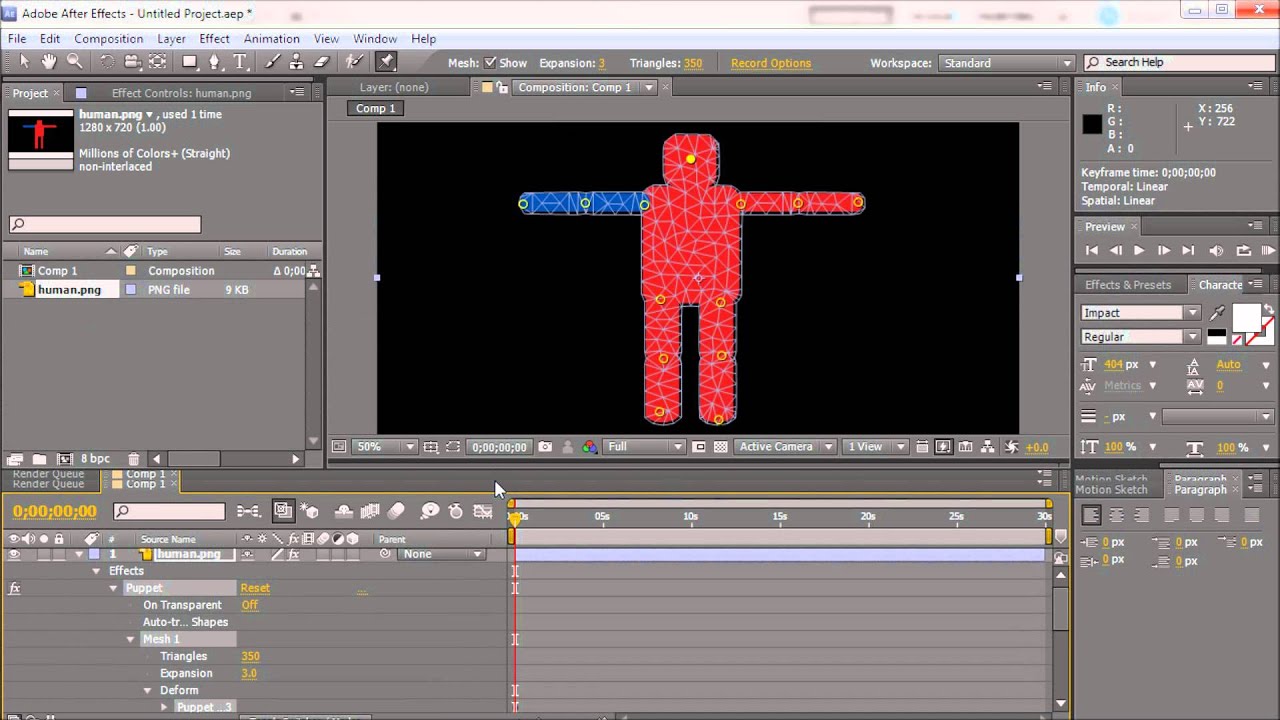
When you move one or more Deform pins, the mesh changes shape to accommodate this movement, while keeping the overall mesh as rigid as possible. The result is that a movement in one part of the image causes natural, life-like movement in other parts of the image. For example, if you place Deform pins in a person’s feet and hands and then move one of the hands to make it wave, the motion in the attached arm is large, but the motion in the waist is small, just as in the real world. If a single animated Deform pin is selected, its Position keyframes are visible in the Composition panel and Layer panel as a motion path.
You can work with these motion paths as you work with other motion paths, including setting keyframes to rove across time. (See.) You can have multiple meshes on one layer. Having multiple meshes on one layer is useful for deforming several parts of an image individually—such as text characters—as well as for deforming multiple instances of the same part of an image, each with a different deformation.
Aug 22, 2012 In this tutorial I'll show you how to use the 'Puppet Pin Tool'. Subscribe to the channel, new video coming soon shortly. FACEBOOK http://www.facebook.com.
The original, undistorted mesh is calculated at the current frame at the time at which you apply the effect. The mesh does not change to accommodate motion in a layer based on motion footage, nor does the mesh update if you replace a layer’s source footage item. Robert Powers provides a video tutorial on the that demonstrates the use of parenting and the Puppet tools to animate a character. Dave Scotland provides a video tutorial on the that demonstrates how to create a looping character animation using the Puppet tools. Harcourt Mathematics 11 Ebook Login. Kert Gartner provides a video tutorial on the that shows how to add organic motion to images using the wiggle expression method on Puppet pins. Daniel Gies provides in which he demonstrates the use of inverse kinematics and the Puppet tools to rig and animate a character.
The stopwatch switch is automatically set for the Position property of a Deform pin as soon as the pin is created. Therefore, a keyframe is set or modified each time that you change the position of a Deform pin. This auto-keyframing is unlike most properties in After Effects, for which you must explicitly set the stopwatch switch by adding a keyframe or an expression to animate each property. The auto-animation of Deform pins makes it convenient to add them and animate them in the Composition panel or Layer panel, without manipulating the properties in the Timeline panel. • Click any nontransparent pixel of a raster layer to apply the Puppet effect and create a mesh for the outline created by auto-tracing the alpha channel of a layer. • Click within a closed path on a vector layer to apply the Puppet effect and create a mesh for the outline defined by that path. • Click within a closed, unlocked mask to apply the Puppet effect and create a mesh for the outline defined by the mask path.